For project #5 Books! I chose to create a book about the cabin my grandfather built for my family before he died. It is a special place for my family because of the care and time he put into building everything. There is no internet connection or cell service at the cabin. So, coloring or drawing is something I do for entertainment. This book is a coloring book made to symbolize the technology free environment the cabin has. I took photos of the building, the area around it, and my family spending time there and turned each into a black and white coloring page.
For project 5, I’ve chosen to for my GIS place the cabin my
grandfather built for my family in Calpine, California. This is a special place
because not only did it take him about ten years to build it, but he died
shortly after completing it. I do not have many memories of my grandfather, who
my sister and I called Papa. He died when I was five. But the cabin has become
a sort of shrine for him. It is filled with paintings and woodworks that he
created and the wooden duck collection he started in his early twenties. My
grandparents had what many would call a whirlwind romance. Originally, the
cabin was going the place my grandparents retired, but Papa had a heart attack
and died in his sleep. My grandmother or Tutu as we call her, has a hard time
staying at the cabin now. She says there are too many memories there.
The cabin has become a place my family has used to get away for a
quick vacation. It’s located in the in a small town called Calpine, which is
just outside Portola, California and thirty-minute drive from Reno. The area is
filled with pine trees and is a little rustic. But Calpine is a peaceful place
that stays cool in the summer and the winter is filled with sledding and
skiing. My mother and her sisters grow up in Calpine until my mom was
five and the family moved to Reno. Papa and Tutu owned a construction and
gravel pit in that area up until he died.
Voodoo Media Doll is a response to the reading Propaganda-Manufacturing Consent by Edward Herman and Noam Chomsky. The body of the doll is stamped with the words news and media meant to represent the visible people in the media. People like news anchors and producers. The suit represents the special interest or parent companies that control an agenda. Finally the pins and fabric are meant to represent the process and scrutiny facts or important information goes through to be considered media or news worthy. My intention was to create a interactive doll that would allow the viewer to play with it to discover the what was stamped on the body. However, unforeseen circumstances had me changing my idea to allowing the audience to try and stab the “facts” through to the fabric of the special interest clothes.
This piece is called Conexus. It is a collaboration exhibition between thirty-two female artist from Brazil and the US. This project, according to the online description, is a letter-writing project intended to gather information and explore the relation between art and culture that take place in each location. This project was created in 1986, making it a unique perspective of women from a generation before my own.
What draw me to the piece was the contrast between the dark red, light cream and black colors. I find this particular color pallet to be pleasing. The picture in the way the book is set up is also really interesting. The separating of the larger book into the small context was great because it lessened the impact and made it more agreeable.
1. Would reinstating the Fairness Doctrine of 1949 be enough to get mass media under control? Would the two main requirements: devoting some airtime to discussing matters of public interest and to air contrasting views regarding those matters, be enough to change the outcome of mass media?
2. Is the "power elite" too ingrained in our society to fully eliminate them? Would this require a complete make-over of our social and political society?
The inspiration for Project #3 came to me from a conversation my sister Natalie and I had. She wants to pursue a career in the Bureau of Land Management here in Nevada. She talked about how much of the BLM’s job is to monitor the wild horses and burros, and how they maintain and track the food and water supplies. My sister wants to a veterinarian, but is interested in the processes used by the BLM to keep the herd numbers for the wild horses and burros at safe level. These herd can double in size every four years, so ever now and then the BLM rounds up young colts and foals for adoption.
My picture is the face of one of our domestic horses Ben and the body of Blackwood. I chose this picture because of the color contrast between Ben, who is a soft yellow color and Blackwood is solid black. Unlike the wild animals this project was inspired by, my horses are friendly and allowed me to take pictures of them a will. Don’t forget wild horses and burros are still wild animals.
This piece is about resisting gender stereotypes. American society puts a great deal of emphasis on gender roles, especially on young children’s trivial toys. To me, this is extremely unhealthy and has a negative impact on a child’s psyche. Each gel transfer is an example of gender expectation or gender divided toy. The genderless babies are a symbol of the unnecessary gender burden American society places on each child. This piece is my way of fighting stereotypes, with the hope that future parent, partially my generation will allow their children to grow and play with whatever the hell they want.
“DOC/UNDOC” by Felicia Rice with collaboration by Guillermo Gomez Pena, Jennifer Gonzalez, Gustavo Vazquez, and Zachary Watkins.
As an avid reading, I understand the potential of a book. It has the potential to change a view point or create a safe space to grow. The Shepard Contemporary Gallery in Church Fine Arts building has an exhibit feature the concept of the book called Expanded Reading: The Book to Come curated by Professor Inge Bruggeman of the art department. The purpose of this exhibit according to the introduction is to “explore the book as art and the book as a site for artistic exploration. In particular, for it to offer an expanded reading experience”. Using a mixture of digital media, the gallery exhibit goes beyond the “mundane chore of storing and conveying everyday utilitarian information” to draw the audience into the “book”. There were books stitched into cloth, or a book turned into a scroll the reader could see as they turned the attached crane. However, the most striking concept of a book was the “DOC/UNDOC” by Felicia Rice with collaboration by Guillermo Gomez Pena, Jennifer Gonzalez, Gustavo Vazquez, and Zachary Watkins.
This piece was created in 2013. It has been placed on a long table, with the pages of the booking laid flat. It appears to be able to folded up with the becoming the cover and back parts of the book. What is most striking about each page is the colorful picture that draws the audience in, which allows them to discover that each page also has a passage hidden on the bottom right hand corner. The significant of this piece that each paragraph tells a small insight into being a Mexican American. For example, one page talks about the reoccurring trend of national security since 9/11, saying at one point “I truly wonder who is scarier? The Tijuana Cartel or the Minutemen? A Chicago gang banger or a Blackwater mercenary?”. This is the beauty of “DOC/UNDOC”. Upon first glance, you think it’s just pages with pretty and creative drawings, but in reality it is a political commentary piece about racism against Hispanics in the U.S. I am drawn to stuff like this because it’s a subtle, yet passionate attempt to express reason and encourage empathy. And I also really like the creative ways these artists interpreted the concept of a book.
Yoshiko Shimada’s Performances of History in
Contemporary Japan
By Jessica Nakamura
Jessica Nakamura’s lecture was about exploring
the image of the comfort women during World War two. Comfort women were
essentially forced prostitutes from Asian countries concurred by the Japanese
army. It is estimated that one hundred to two hundred thousand women from the countries of Korea, China, Vietnam, and even Japan were forced to sexually serve
an average of 20 to 60 men a day. The army saw these women as supplies for the
men, but conditions were often horrible. Many women were as young as 15 years
old when taking and were often left behind or killed when the army retreated.
Today, Japan sees this history as a stain on their image, even going to great
lengths to destroy evidence and documentation. According to Ms. Nakamura, there
is a taboo that follows women who identify or say they were used as comfort
women. However, in 1991 former comfort women took their fight to the court
systems in Japan. As of 2015, there was some recognition on the Japanese government
but they can with stipulations many people were hesitated to agree too.
Ms.
Nakamura focuses are Yoshiko Shimada’s “Becoming a Statue of a Japanese Comfort
Woman” 2012. Shimada started her work during the early 1990s, when the comfort
women went to court, because many Japanese people were unaware of this dark
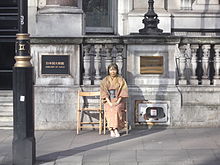
history. This piece, performed in London outside the Japanese Embassy as a
reaction the government denial to recognize them. Nakamure argues that Shimada’s
piece demands the audience (people walking by) engage with her physical form,
creating a relationship. Because youth of Japan isn’t aware of the role of
comfort women in WW2, Shimada intents to stop the brainwashing and force them
to recognize and interact with the symbolism of Japanese violence and
aggression towards women.
Nakamura also discussed the Bronze statue in Seoul
Korea (also outside the Japanese Embassy). The piece is an image of a woman
sitting with her feet and hand placed flat. Nakamure argues that the statue
explores the idea of female sexuality, meaning the audience calls the statue “grandmother”
essentially erasing her sexuality, which in turn, diminishes the horrible
conditions these women went through.
Overall, the lecture was
a reminder to the younger generations about the horrors of war and the violence
it inflicts on people. Sadly, many comfort women have not come forward and
those who have, many not live long enough to see any compensation from the
Japanese government. However, Jessica Nakamura does end on a positive note: Yoshiko
Shimada’s piece and other comfort women statues around the world will continue
to stand and serve as a reminder of injustices and violence towards women.
For my artist statement, I would like to focus on learning to develop my techniques with the projects we use in Art 343 and Art 350. My projects will be based on my personality, my interests and possibly my beliefs. My main focus with be to understand systems like Maya, Adobe Photoshop and other Adobe systems. I think the ability to create is my favorite part of art. I enjoy contemporary art. I also identify with feminism based art work. I think I will be influenced by the politic atmosphere I see today.