Becoming a Missing Comfort Women
Yoshiko Shimada’s Performances of History in
Contemporary Japan
By Jessica Nakamura
Jessica Nakamura’s lecture was about exploring
the image of the comfort women during World War two. Comfort women were
essentially forced prostitutes from Asian countries concurred by the Japanese
army. It is estimated that one hundred to two hundred thousand women from the countries of Korea, China, Vietnam, and even Japan were forced to sexually serve
an average of 20 to 60 men a day. The army saw these women as supplies for the
men, but conditions were often horrible. Many women were as young as 15 years
old when taking and were often left behind or killed when the army retreated.
Today, Japan sees this history as a stain on their image, even going to great
lengths to destroy evidence and documentation. According to Ms. Nakamura, there
is a taboo that follows women who identify or say they were used as comfort
women. However, in 1991 former comfort women took their fight to the court
systems in Japan. As of 2015, there was some recognition on the Japanese government
but they can with stipulations many people were hesitated to agree too.
Ms.
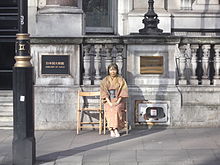
Nakamura focuses are Yoshiko Shimada’s “Becoming a Statue of a Japanese Comfort
Woman” 2012. Shimada started her work during the early 1990s, when the comfort
women went to court, because many Japanese people were unaware of this dark
history. This piece, performed in London outside the Japanese Embassy as a
reaction the government denial to recognize them. Nakamure argues that Shimada’s
piece demands the audience (people walking by) engage with her physical form,
creating a relationship. Because youth of Japan isn’t aware of the role of
comfort women in WW2, Shimada intents to stop the brainwashing and force them
to recognize and interact with the symbolism of Japanese violence and
aggression towards women.

Nakamura also discussed the Bronze statue in Seoul
Korea (also outside the Japanese Embassy). The piece is an image of a woman
sitting with her feet and hand placed flat. Nakamure argues that the statue
explores the idea of female sexuality, meaning the audience calls the statue “grandmother”
essentially erasing her sexuality, which in turn, diminishes the horrible
conditions these women went through.
Overall, the lecture was
a reminder to the younger generations about the horrors of war and the violence
it inflicts on people. Sadly, many comfort women have not come forward and
those who have, many not live long enough to see any compensation from the
Japanese government. However, Jessica Nakamura does end on a positive note: Yoshiko
Shimada’s piece and other comfort women statues around the world will continue
to stand and serve as a reminder of injustices and violence towards women.

No comments:
Post a Comment